Our Work

Community Impact and Peer Support

Beyond our institutional and policy work, SEMA’s impact is felt most directly in the lives of individuals who have never before had access to culturally relevant autism support. We have identified and supported struggling adults who questioned whether they were Autistic, guiding them through the assessment process. We have provided one-to-one consultations in Urdu with South Asian parents navigating the challenges of supporting Autistic teenagers. Through community group training delivered across central Scotland, we have meaningfully reduced the stigma around the label of autism in communities where it remains deeply misunderstood.

SEMA has delivered in-person seminars in Stirling for madrasah volunteers and carers, including the first translation of sensory difference and Autistic experience information into Urdu for participants in that setting. We have also delivered community training for NKS Edinburgh, a South Asian family group, following which several women self-identified as Autistic and sought further advice for their children.

SEMA runs a peer support WhatsApp group for adult Autistics, including those who are late identified. We also facilitate a carers support group where carers can bring questions directly to Autistic adults. Our community training, delivered in Urdu, continues to reach families who would otherwise have no access to autism information in their own language.

Funded Projects

Ethnic Minority Development Fund

Community Training Working to Improve Understanding and Remove the Stigma.

Our current community partners include Boots and Beards (Glasgow), NKS (Edinburgh) and RISE Forth Valley. We look forward to working with the wide range of minority ethnic community groups across Scotland. 

SEMA is currently delivering a community training programme for several community groups in Urdu and English, covering what being autistic is like, common myths, communication and sensory differences, co-occurring conditions, and how to support loved ones. Through this project we have worked with ten groups with 5 organisations, created four Urdu information videos and an animation in Urdu and Pashtu. More animations are under production. This community ambassador training is funded by the Ethnic Minority Development Fund from the National Lottery Community Fund Scotland. 

Please get in touch if you would like your organisation and members to benefit from this opportunity. 

Feedback from community participants who attended SEMA’s training series

Improving Access Fund

Late Diagnosed/Identification Support Course

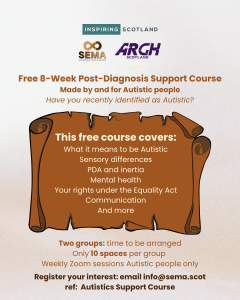
In partnership with ARGH Scotland, SEMA developed a post-diagnosis and late identification course addressing the gap in support that many racialised Autistic adults face following a late diagnosis, providing culturally relevant information and peer connection at a critical and often isolating time.

This opportunity will be particularly useful for those who have not been able to access support or receive information to help them understand what being autistic means, and what support is available.

By the end of the course, you will have a better understanding of:

▸What it means to be Autistic
▸ How to make sense of your autistic experiences
▸ How to explain to others what it means to be Autistic
▸ Your rights under the Equality Act, and what support you can request in education and work
▸ Topics including sensory experiences, monotropism, mental health, communication, and more

Sessions run weekly via Zoom. There are limited spaces per group, with times and dates to be arranged to suit participants.

These sessions are designed to support Autistic people themselves. You are welcome to attend with someone who supports you with communication or emotional needs. To maintain a safe space for Autistic participants, we kindly ask that non-Autistic people not contribute their own views or experiences during group discussions.

Register your interest by emailing  info@sema.scot with subject: Late Identification Course

Adult Autistic Support Fund

2025-2028

SEMA is a key partner in the Autistic Adult Support Fund 2025-2028, consulting and delivering training to nine organisations across Scotland that support Autistic adults. This enables us to embed culturally competent, anti-racist practice across a wide portfolio of organisations simultaneously. We will post more information on this project under the AASF 2025-2028 page. 

2024-2025

We conducted community research and produced e-books and training based on lived experiences of Scottish racialised Autistics. This work aimed to inform service providers on how to accommodate those with intersectional identities. If your organisation works with racialised people and/or autistic people, we highly recommend that you read the e-books and book in the training with us. When developing strategies and policies, please consider the impact on people like us. You can find the material on our AASF 2024-2025 page.  

Feedback from participants who attended SEMA's community training

“I really enjoyed today's series. Thank you Sofia for creating such amazing work. This series does help understand Autistic people. Lots of myths will be cleared by the end of these sessions. I hope more people will attend the remaining series to achieve the knowledge and understanding of what it is like being an Autistic person.”

G
G | Training participant

“I learned that being Autistic affects people in very different ways, especially in how they experience sensory input and communication. The seminar helped me understand how everyday environments can be overwhelming. I also learned that many Autistic people develop intense interests and unique ways of thinking, which can lead to creativity, expertise, and high achievement when supported.”

M
M | Training participant

“Listening to Sofia helped me learn so many new things, including things I wasn't even aware of. It built so much awareness for me. It was a really good seminar.”

Z
Z | Training participant

“The training, especially the way it was explained, was very interesting and engaging. It helped clear misconceptions, and her personal experiences added a lot of value. Overall, it was very positive, informative, and interesting.”

F
F | Training participant

“The training was very good and provided a lot of useful information. Many common issues that people experience at home were addressed, which made it especially relevant. The subject itself was very good and much needed.”

Y
Y | Training participant

“I learned that the main point is that it is not a disease, as we think it is, and it is not caused by vaccination. Autistic people memorise and learn information very quickly.”

A
A | Training participant

“The session was very motivating, very informative, and everybody enjoyed learning and finding out lots of information about Autistic people.”

S
S | Training participant

“I learned that Autism and mental health are two very different things”

N
NKS Community Training participant

“Listening to her made me realise my approach to my son was wrong in some situations, and I understood why he reacted the way he did.”

R
RMWG Community Training participant

“It was a great training session with good vibes and good lived experiences, which made it fun as well. That was very integral to the training, because when you enjoy what you are doing, you do it better and with more enthusiasm.”

B
B&B Community Training participant

Resources and Publications

PDA - Animated Video

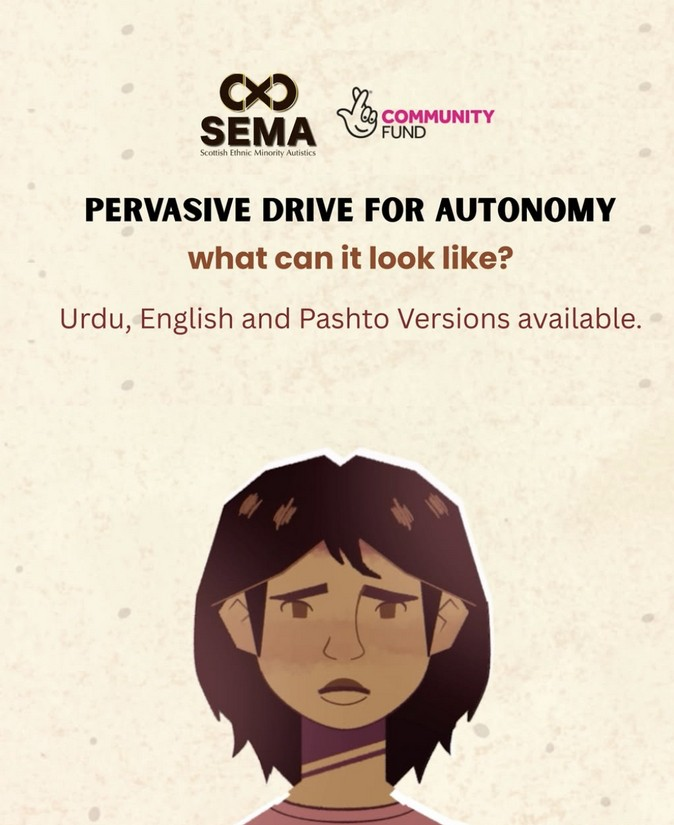
SEMA produced an animated video exploring what Pervasive Drive for Autonomy (PDA) can feel like, both from the outside and from within.  The video was produced in English, Urdu, Arabic and Pashtu, believed to be the first resource of its kind on PDA in these languages. SEMA hopes to expand into further languages. Funded by the National Lottery Community Fund

Autistic Ramadan E-book

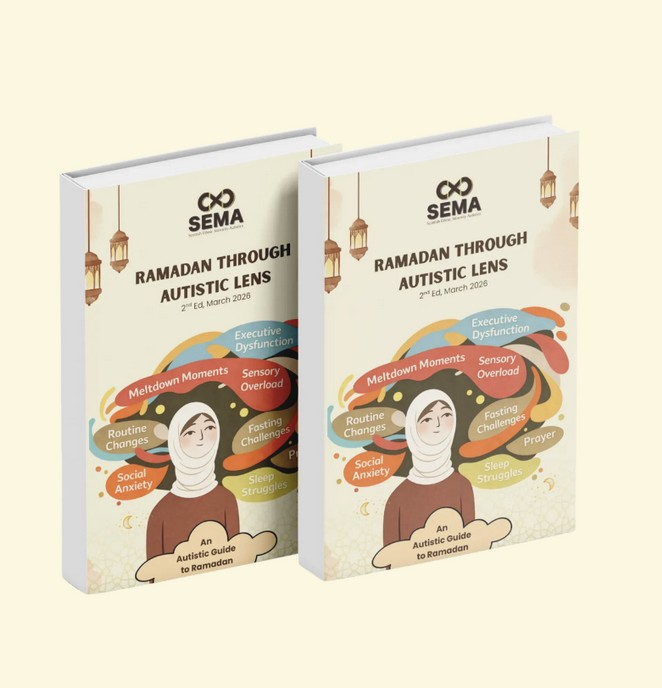
SEMA published the Autistic Ramadan e-book, a landmark resource making culturally specific content available to Muslim Autistic people and their families across the world. It was developed with input from service users, partner organisations, and fellow Autistic advocates, and was designed with the understanding that its learning does not apply exclusively to Muslims or to Autistic people. We hope people from many diverse backgrounds will find it relevant and relatable.

Urdu Video Series: What is Autism?

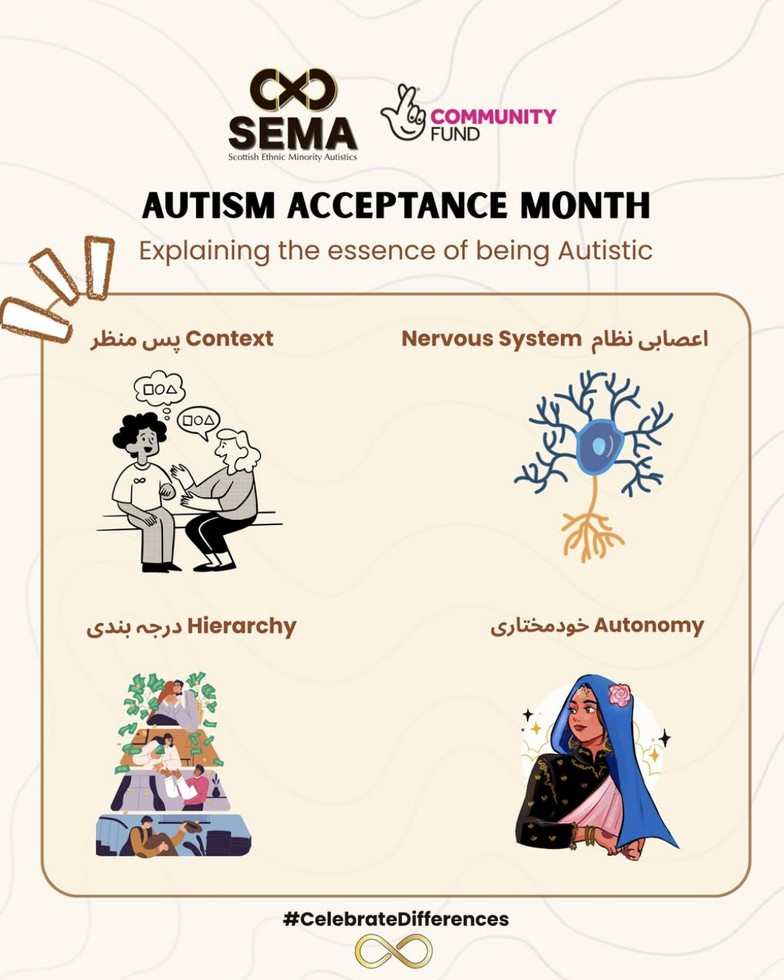
As part of Autism Acceptance Month, SEMA created a short video series in Urdu with English subtitles, exploring autism through lived experience rather than clinical definitions. The series centred four key concepts: Nervous System (اعصابی نظام), Hierarchy (درجہ بندی), Autonomy (خودمختاری), and Context (پس منظر), each designed to make these ideas accessible for communities who rarely see autism explained in culturally relevant ways. A key learning from this work was that translation must consider cultural context and reference points, not just language. This now shapes how SEMA approaches all multilingual resource development. Funded by the National Lottery Community Fund.

Lived Experiences E-Books

SEMA has collected the lived experiences of racialised Autistic adults and developed these into e-books. View resources here: https://sema.scot/AASF. Notably, our Check Your Privilege Quiz has been instrumental in each of our training for service providers.

Policy and Government Engagement

Scottish Parliament Inquiries: Evidence Submissions

SEMA gave evidence to two Scottish Parliament Inquiries on Neurodivergence, placing the experiences of racialised Autistic people directly before lawmakers and reinforcing SEMA’s position as the leading voice on the intersection of race, faith, and neurodivergence in Scotland.

The  Scottish Parliament Health, Social Care and Sport Committee’s Report on the ADHD and autism pathways and support inquiry has now been published: ADHD and autism pathways and support | Scottish Parliament 

Equalities, Human Rights and Civil Justice Committee’s Legacy Report for Session 6 has now been published.

LDAN Bill

SEMA has been a named stakeholder in the development of the LDAN Bill since 2022, working directly with civil servants and fellow stakeholders to ensure neurodivergent People of Colour were represented in the shaping of the legislation. Sofia spoke at an official stakeholder and professionals’ group event, explicitly highlighting the serious shortcomings in policy, training, and the genuine understanding of intersectional identities within the public sector. She has been the only non-white racialised neurodivergent voice in many of these meetings, and has raised on multiple occasions the need to include co mmunities beyond the white middle class when shaping legislation. We continue to be active Stakeholders in the LDAN Bill consultation stage. The Government Paper was produced earlier in 2026. We welcome the anti-racism and intersectional approach the the LDAN Bill team have adopted in their planning following from our work with them. We appreciate the acknowledgement in the Partial EQIA Assessment.

Community Consultations

In 2024 SEMA also delivered successful community consultations on behalf of the Scottish Government as outreach work increasing participation in the LDAN Bill consultation. We delivered information sessions for ethnic minority-led organisations and recruited community members to translate the consultation, in audio/video format, into nine languages, each with a personal and emotional connection to the cause: Arabic, French, Latin Spanish, Igbo, Polish, Swahili, Shona, Mandarin, and Urdu. This is the first time this approach has been taken for a Scottish Government consultation.

We also produced a report that summarised the findings of the Learning Disability, Autism and Neurodiversity Bill pre-consultation exercise. It is an analysis of 30 workshops carried by the Scottish Government and its partners including SEMA with people with learning disabilities and autistic people.

Cross Party Group on Autism

SEMA is part of the Cross Party Group on Autism. We co-organised one of the sessions in 2025 on racial intersectionality which included lived experiences of minority ethnic autistics, carers and a new community group. Previously, we took the Meet the Member slot, resulting in new connections with the Govan Law Education Advocacy Centre and the Centre for Autism Research and Education at Strathclyde University (CARES). SEMA remains the only non-white voice in these meetings and consistently highlights the discrimination and barriers that racialised Autistic people face across all aspects of life in Scotland.

Scottish Government Mental Health Strategy

Sofia served as a policy contributor to the Scottish Government mental health strategy for Autistic people, advocating for the needs of racialised Autistic individuals and highlighting the racial biases and discrimination that Black and Brown Autistic people face within mental health services.

Research Contributions

State of Play

A Snapshot Survey of Autistic Disabled People’s Organisations Members’ Experiences of Education, Employment, and the Criminal Justice System in Scotland, January 2026

In 2025, SEMA collaborated with ARGH Scotland and AMASE to survey and produce a report on the experiences of Scottish Autistics regarding Education, Employment and Justice.

Although this report offers a glimpse of the issues we face, it makes a strong case for further in-depth investigation to shape policy and practice.

It was written in response to the EHRCJ Committee Inquiry into Neurodiversity, where evidence was also provided along with AVATAR & Aurora Autistic Consulting.

View Report

Experiences of Autism Assessment and Diagnosis in Scotland

SEMA, collaborated with Scottish Autism, ARGH and AMASE to research the experiences of autism assessments in Scotland. The data was collected in 2023 and this report was delivered to the Scottish Government SPICe meeting in October 2025.

We argued that community based assessments were found to be most accessible while advocating for holistic neurodevelopmental assessments and more post identification/ diagnosis support to be put in place.

Read the full report

Training, Consultancy & Other Projects

Delivering training and consultancy to institutions and organisations is one of SEMA’s core functions.

Our training challenges predominantly white institutions to genuinely understand and respond to the intersectional experiences of racialised Autistic people, and supports them to embed that understanding into their policies, practices, and resources.

Zero Tolerance

In June we joined up with Aurora Autistic Consulting to deliver professional training called Under Pressure: Neurodiversity & Intersectionality in Young People discussing prevention and impact of abuse on Autistic young people, especially from queer and racialised perspectives.  

SWAN Resource for Professionals 

In May 2026, SEMA contributed to a professional resource produced by the Scottish Women’s Autistic Network, called ‘Understanding and Supporting Autistic Survivors: Professional Development Guide’, ensuring it reflects the experiences of racialised Autistic women and challenges professionals to move beyond a white, western lens.

NHS 

We have contributed to NHS Glasgow CAMHS and the NHS Glasgow Autism and ADHD Policy team. SEMA also contributed to NHS Student Doctor training scenario development, and was invited to review NHS Glasgow’s written ADHD support resource for cultural relevance and accessibility. Members from SEMA collectively gave feedback on ADHD resources being produced for patients in NHS GGC while our directors continue to feed into their autism and ADHD strategy. We welcome the opportunity to consult and advise on how to improve service provision for racialised neurodivergent patients. We also have worked with CAMHS in the planning of a research project on carers’ experiences. 

Talking Mats: Faith and Beliefs Communication Symbols

SEMA was part of the Talking Mats consultation on new Faith and Beliefs communication symbols, aimed at supporting more accessible and culturally grounded conversations on faith and identity for Autistic people. The symbols were soft-launched at the Faith on the Margins conference in Autumn 2025. 

Glasgow University: Neurodiversity in Scottish Schools

SEMA contributed to Glasgow University’s Neurodiversity in Scottish Schools Project, bringing the perspective of racialised neurodivergent learners into academic research on inclusion in Scottish education.

Holyrood Insights CPD Events

Sofia has been a featured speaker at multiple Holyrood Insights in-person CPD events, including Neurodiversity in the Classroom (2024) and Neurodiversity in the Workplace (2023, 2024, and 2025), presenting as a racialised Autistic and ADHD trainer. These events reach education and workplace professionals across Scotland at a national level.

Education Scotland: Building Racial Literacy Summits

Sofia has been a panelist at Education Scotland’s Building Racial Literacy Summit on three separate occasions, consistently supporting Scottish teachers to challenge their understanding of the intersectionality of race and neurodivergence and reflect on how their practice can be more genuinely inclusive.

Learning Places Scotland  Conference 

SEMA contributed to the Scottish Learning Places Conference in autumn 2024, alongside Fergus Murray from AMASE and Marion McLaughlin, a former teacher from Aurora Autistic Consulting, bringing SEMA’s perspective on racialised neurodivergent learners into a national education forum. We discussed the impact of inappropriate and unaccommodating to the learning for and wellbeing of neurodivergent young people. 

Neurobears

We had the privilege to contribute to the Neurobears new video resource Unpacking Understanding which helps teens to explore what being neurodivergent means. Having diverse audience means that it is important that the course offers representative voices to help young people 

GP Training: Intersectionality Video 

SEMA members created the script for a GP training video on intersectionality, produced by Autism Initiatives, to support NHS doctors in understanding how race, culture, faith, and neurodivergence intersect in a clinical setting. 

Strathclyde University CARES: Project Consultation

SEMA was consulted by the Centre for Autism Research and Education (CARES) at Strathclyde University on a new research project, providing input to ensure it reflects the experiences of racialised Autistic learners with a focus on inclusive research practices, cultural representation, and the relevance of education-based autism studies to communities that are routinely excluded from academic research.

Scottish Government Different Minds Campaign 

Sofia undertook consultancy work with Inspiring Scotland and contributed to the Scottish Government Different Minds campaign. At her request, the Myth Busting Booklet was translated into multiple languages, with printed Urdu, Arabic, and Punjabi versions distributed locally. Sofia featured in the campaign’s media work including the Social Rule Book video series, representing the first time a non-white and visibly Muslim person appeared in autism support media materials in Scotland.

Stakeholder Toolkit
Webinars

Webinars have been a central part of how SEMA reaches communities who have historically had no access to culturally relevant autism information.

The following outlines the key webinar work we have delivered and participated in.

YouTube Webinars with Autistic-Led Organisations

SEMA has delivered and participated in a range of YouTube webinars in collaboration with other Autistic-led organisations, extending reach beyond Scotland and making lived experience-led content on race, faith, and neurodivergence accessible to a global audience.

Hypermobility and Neurodivergence

To mark the International Day of the Disabled Person, SEMA hosted a webinar on connective tissue conditions and their link to neurodivergence. Sofia was joined by Jane Green MBE from SEDS Connective and Kabie from ARGH Scotland to explore hypermobility and other connective tissue conditions alongside neurodivergence. The session addressed the mind-body connection, often overlooked in a field that tends to view neurodivergence primarily through the lens of behaviour, and aimed to give participants language they could use with loved ones, healthcare professionals, and educational institutions.

Impact of Colonialism on Autistic People

Sofia spoke at a webinar presented by the Autistic Burnout Network alongside Claire Betson and Viv Dawes, exploring how colonialism has shaped the treatment, understanding, and lived experiences of Autistic people across different societies. The webinar examined how colonial systems define whose voices are heard and whose are dismissed; the impact of migration, displacement, and climate; and intersectionality, identity, and the politics of belonging. A percentage of ticket sales was donated to Medical Aid for Palestine. You can watch this webinar for free on Youtube

Autistic Burnout Conference

Sofia delivered talks at the Autistic Burnout Conference in 2025 and 2026, in collaboration with Neuro by Nature, raising the profile of racialised Autistic experiences within conversations about burnout, a widely underrecognised area of Autistic wellbeing.

Faith on the Margins Conference and Autism and Spirituality

Sofia spoke at the Faith on the Margins conference hosted by the Aberdeen Institute of Autism and Spirituality, presenting on Panel 1: Autism in Islam and Buddhism alongside Dr Sofia Rehman and Marion McLaughlin, reflecting on the intersections of Autistic identity, spiritual life, and community belonging. SEMA has also delivered an Autism and Spirituality webinar through the Aberdeen Institute.

Autistic Ramadan Webinar

SEMA delivered Autistic Ramadan webinar exploring how the demands of Ramadan intersect with sensory needs, Autistic burnout, and neurodivergent experience, joined by Dr Sofia Rehman. These were among the first resources of their kind created by and for Muslim Autistic people. You can find them on our YouTube channel. 

SWAN Scotland

The Multi-Layer Experience of Being Me was a webinar that Sofia delivered in late 2024 to members of SWAN, where told her story of self discovery, peeling away the layers of her identities that stopped her feeling ‘normal’ and fit in. Many of the audience could relate and some also joined the SEMA support group after the talk. 

Autistic Parents UK

In autumn 2024, members of Autistic Parents UK were invited to listen to experiences of a racialised Autistic parent, the challenges and the advantages of having the same neurotype as you children, but also navigating system barriers including ableism, racism and sexism. Many could relate the experiences, even though they were set in the Scottish context. 

East Renfrewshire Minority Ethnic Carers: Autism Understanding Webinars

SEMA delivered four Autism Understanding webinars for minority ethnic carers in East Renfrewshire, in partnership with The Autistic Collective CIC and the East Renfrewshire Carers Centre. These provided, for the first time, a safe and culturally informed space for South Asian, Polish, Arab, and Black carers of Autistic children to understand autism through the lens of their own communities. Webinar 4 used Ramadan and yearly religious observances as a lens to explore Autistic sensory needs and burnout. SEMA also produced the first Urdu and Arabic translated webinar on ‘What is Autism?’ for the East Renfrewshire Carers Centre. 

Webinar 1: Introduction to Autism was translated into into Urdu, Arabic were also produced 2024 and can access by emailing hello@autistic-collective.org 

Feedback from webinar attendees:


“Thank you for the very informative session. Never attended any one like this before.”

B
Webinar participant B

“I would like my daughter to be able to listen to you. It is so near what she is going through.”

C
Webinar participant C

“I think that my traditional family will also respect more what comes from a Muslim person.”

D
Webinar participant D

“Excellent webinar. Loved the fact that Laura and Sofia are so inspiring with everything they are involved in, and the part they are able to relate to Black and ethnic minorities. It’s so crucial that we have this.”

E
Webinar participant E

“You are a total inspiration Sofia, an absolute legend and you help so many people! Laura too. The Autistic community would be so truly underrepresented without you both.”

A
The Autistic Collective Team

“I would like my daughter to be able to listen to you. It is so near what she is going through.”

C
Webinar participant C

“I think that my traditional family will also respect more what comes from a Muslim person.”

D
Webinar participant D

“Excellent webinar. Loved the fact that Laura and Sofia are so inspiring with everything they are involved in, and the part they are able to relate to Black and ethnic minorities. It’s so crucial that we have this.”

E
Webinar participant E

“You are a total inspiration Sofia, an absolute legend and you help so many people! Laura too. The Autistic community would be so truly underrepresented without you both.”

A
The Autistic Collective Team
Skip to content